Lecture 16: Heat Engines and the Second Law
CBE 20260 / Thermodynamics I
1 Introduction: Heat vs. Work
So far, we have covered energy and entropy balances for various pieces of process equipment (pumps, compressors, turbines, etc.). Now we want to “put it all together” to produce Work.
Why focus on work? While heat is useful (warming our homes), work is especially valuable because it is an organized form of energy transfer. We use it to move things (cars, planes), generate electricity, and drive chemical processes.
There is a fundamental asymmetry between heat and work:
- Work \(\to\) Heat: Easy. We do this all the time via friction (rubbing hands together), electrical resistance, or Joule’s paddlewheel experiment. It is 100% efficient.
- Heat \(\to\) Work: Hard. We cannot simply convert 100% of heat into work.
To understand why, we will analyze abstract “devices” that attempt these conversions.
Remember, in this class we use the IUPAC sign convention:
\(Q > 0\): Heat is transferred into the system.
\(W > 0\): Work is done on the system.
Therefore, a device that produces work will have \(W < 0\), and a device that rejects heat will have \(Q < 0\).
2 The Kelvin-Planck Device
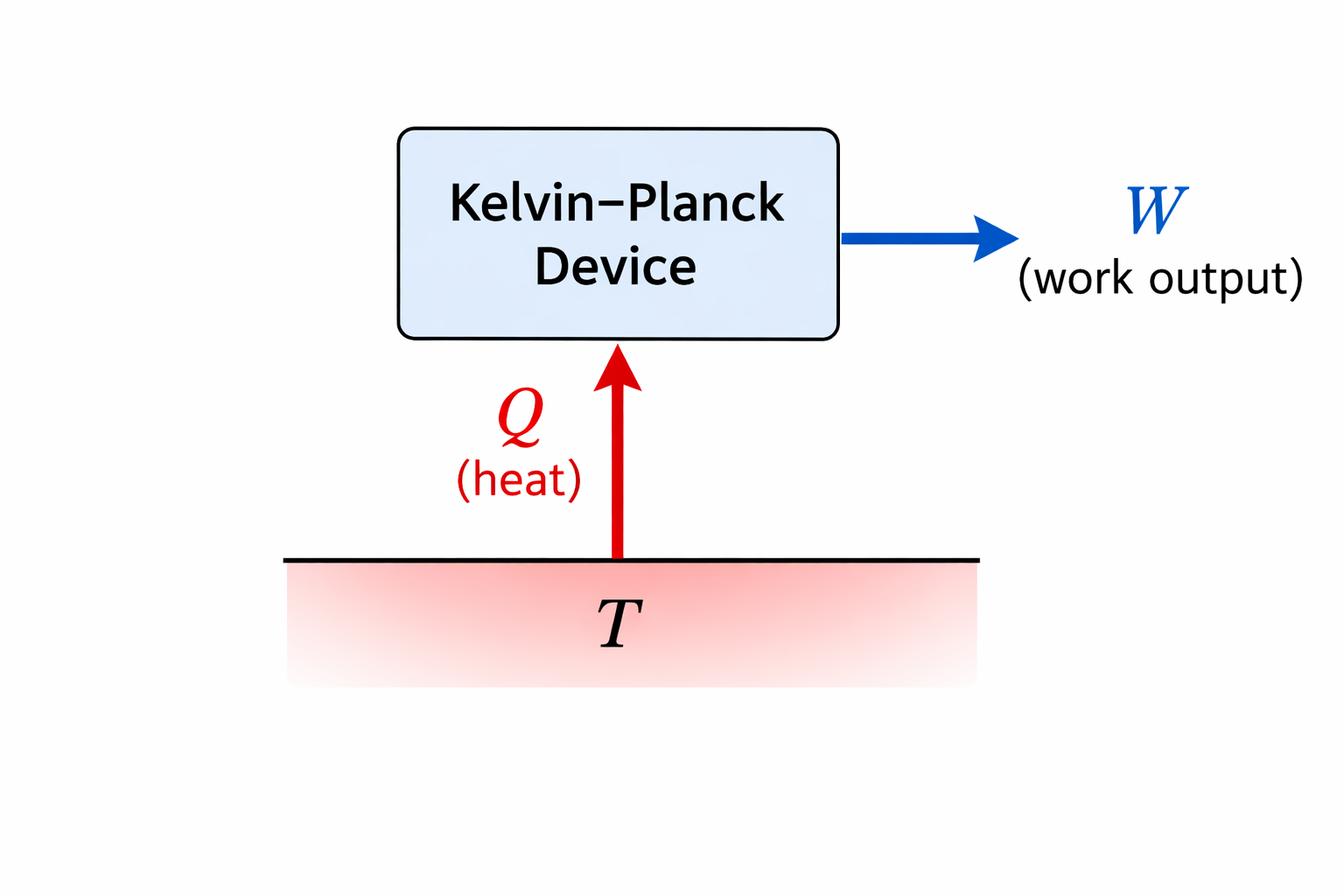
Let’s imagine a steady-state device that takes in heat (\(Q\)) from a single thermal reservoir at temperature \(T\) and converts it entirely into work (\(W\)). We call this a Kelvin-Planck Device.
2.1 Analysis
Consider this device operating in a cycle (i.e. steady state). Let’s apply our balances:
First Law: \[\Delta U = 0 = Q + W \implies W = -Q\] If the device takes in heat (\(Q > 0\)), then \(W < 0\). This means work is produced by the system. According to the First Law, this device is possible. Energy is conserved.
Second Law: \[\Delta S = 0 = \frac{Q}{T} + S_{gen}\] \[S_{gen} = -\frac{Q}{T}\]
Since \(Q > 0\) (heat added) and absolute temperature \(T > 0\), this implies: \[S_{gen} < 0\] This violates the Second Law! Entropy generation (\(S_{gen}\)) must be \(\ge 0\).
It is impossible to construct a device that operates in a cycle and produces no other effect than the production of work and transfer of heat from a single body. (i.e., You cannot turn heat 100% into work).
2.2 The Reverse Kelvin-Planck Device
What if we reverse the arrows? A device that takes work in and turns it entirely into heat rejected to a reservoir?
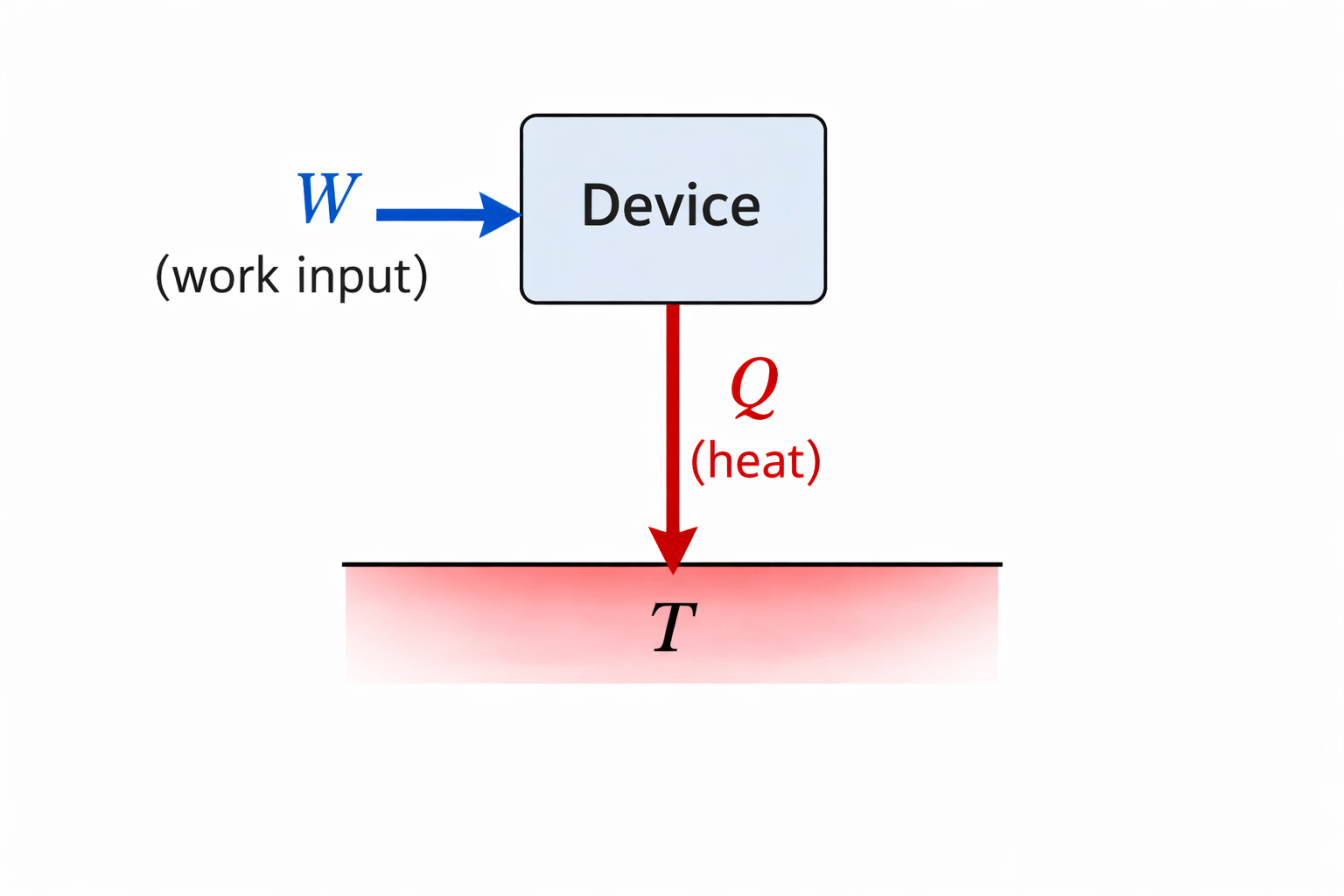
1st Law: \(\Delta U = 0 = Q + W \implies Q = -W\). If work is put in (\(W > 0\)), heat is rejected (\(Q < 0\)). This is Possible from an energy balance perspective.
2nd Law: \(\Delta S = 0 = \frac{Q}{T} + S_{gen} \implies S_{gen} = -\frac{Q}{T}\). Since \(Q < 0\), \(S_{gen} > 0\).
Since \(Q < 0\), the term \(-\frac{Q}{T}\) is positive, meaning \(S_{gen} > 0\). This is Possible. This suggests that work can be converted 100% to heat. An electrical resistor is a perfect example of this.
3 The Clausius Device
Now consider a device that transfers heat from a cold reservoir (\(T_C\)) to a hot reservoir (\(T_H\)) without any work input.
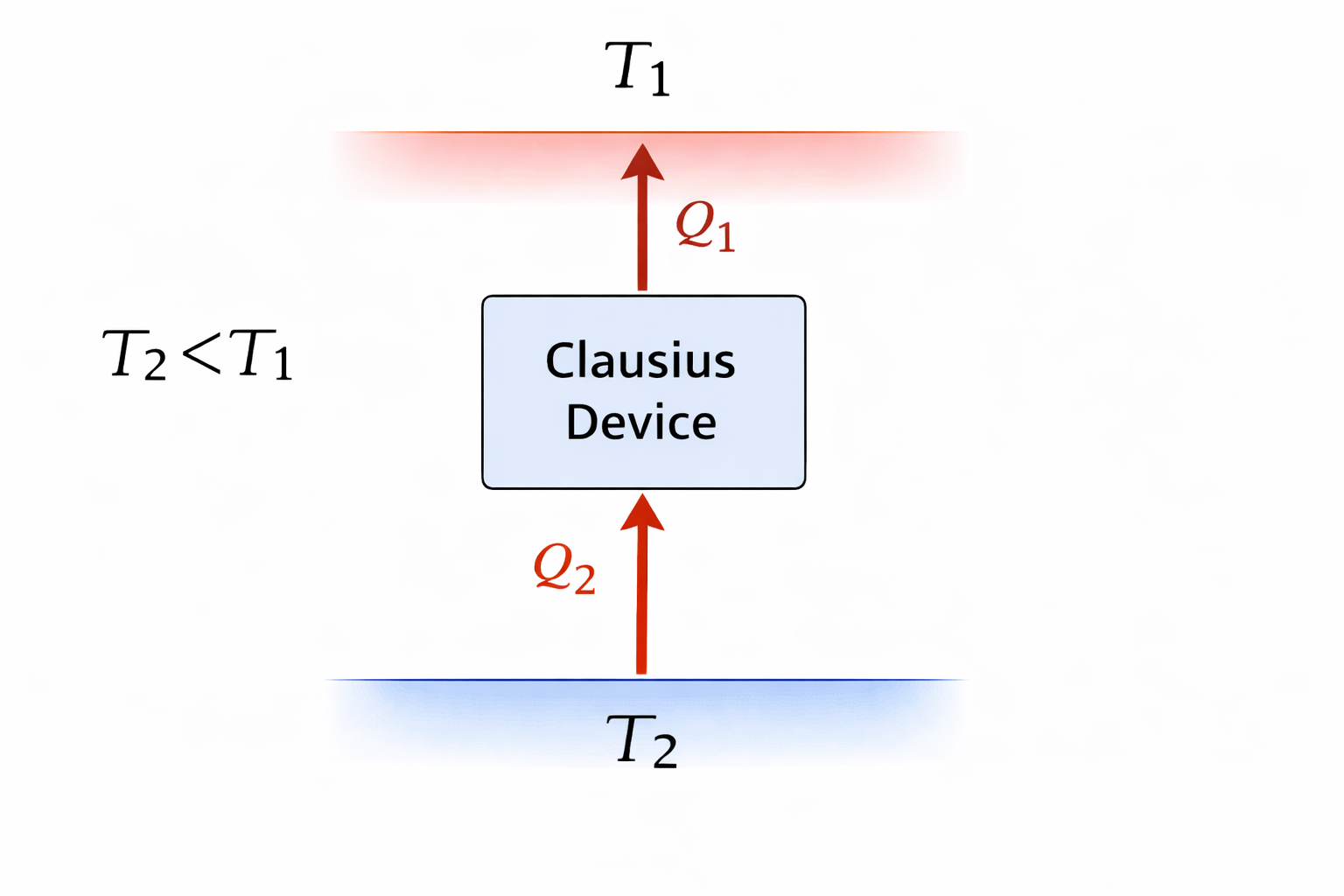
In Fig. 3, 2 is the cold (C) reservoir and 1 is the hot (H) reservoir. Heat flows from 2 to 1, which is the opposite of the natural direction of heat flow.
First Law: \[0 = Q_H + Q_C + W\] Since there is no work (\(W = 0\)), \(Q_H = -Q_C\). Heat is absorbed from the cold reservoir (\(Q_C > 0\)) and rejected to the hot reservoir (\(Q_H < 0\)). This is Possible from an energy balance perspective.
Second Law: \[0 = \frac{Q_H}{T_H} + \frac{Q_C}{T_C} + S_{gen}\] Substitute \(Q_H = -Q_C\): \[0 = -\frac{Q_C}{T_H} + \frac{Q_C}{T_C} + S_{gen}\] \[S_{gen} = -Q_C \left( \frac{1}{T_C} - \frac{1}{T_H} \right)\]
Since \(T_H > T_C\), the term \((\frac{1}{T_C} - \frac{1}{T_H})\) is positive. Because \(Q_C > 0\), the entire right side is negative. Therefore, \(S_{gen} < 0\). Impossible. Heat cannot spontaneously flow from cold to hot.
It is impossible to construct a device that operates in a cycle and produces no other effect than the transfer of heat from a lower-temperature body to a higher-temperature body.
(Note: We can show that a Clausius device is conceptually identical to a combined Kelvin-Planck and reverse Kelvin-Planck device!) Since the KP device is not allowed, neither is a Clausius device
3.1 The Reverse Clausius Device
A “Reverse Clausius” device is one that allows heat to flow naturally from hot (\(T_H\)) to cold (\(T_C\)). This is a common process in nature.
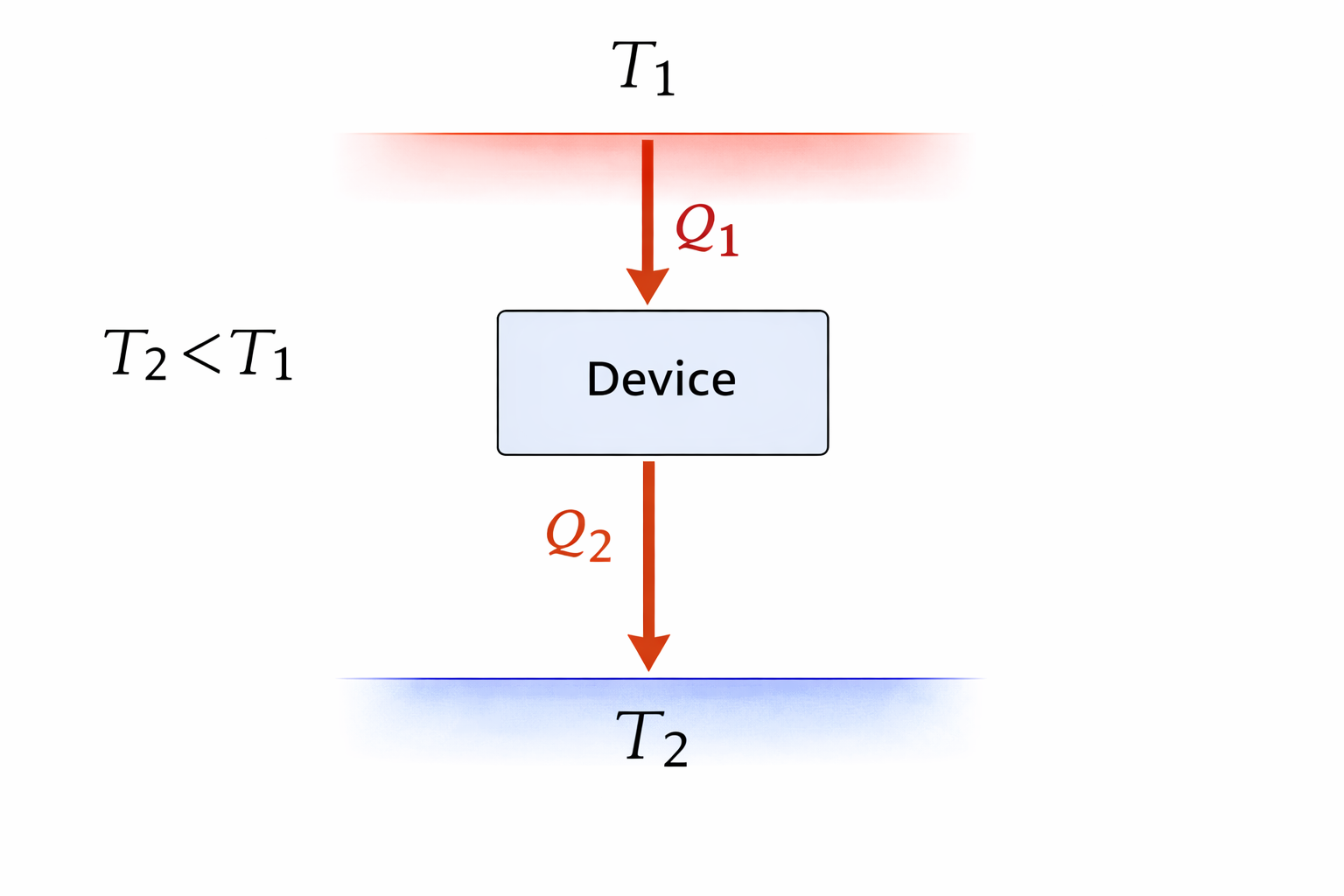
Let’s do a thermodynamic analysis anyway. \(Q_H > 0\) (heat in) and \(Q_C < 0\) (heat out). \[S_{gen} = -Q_H \left( \frac{1}{T_H} - \frac{1}{T_C} \right)\] Since \((1/T_H - 1/T_C)\) is negative, and \(Q_H > 0\), \(S_{gen} > 0\). Possible. Heat naturally flows from hot to cold.
4 The Cyclic Heat Engine
We have established three facts:
We can convert work 100% to heat (reverse KP device is possible).
We cannot convert heat 100% to work (\(S_{gen} < 0\)).
Heat naturally flows from \(T_H\) to \(T_C\) (\(S_{gen} > 0\)).
The Engineering Idea: What if we take the natural flow of heat from \(T_H\) to \(T_C\) (which generates positive entropy) and “bleed off” some of that energy as work?
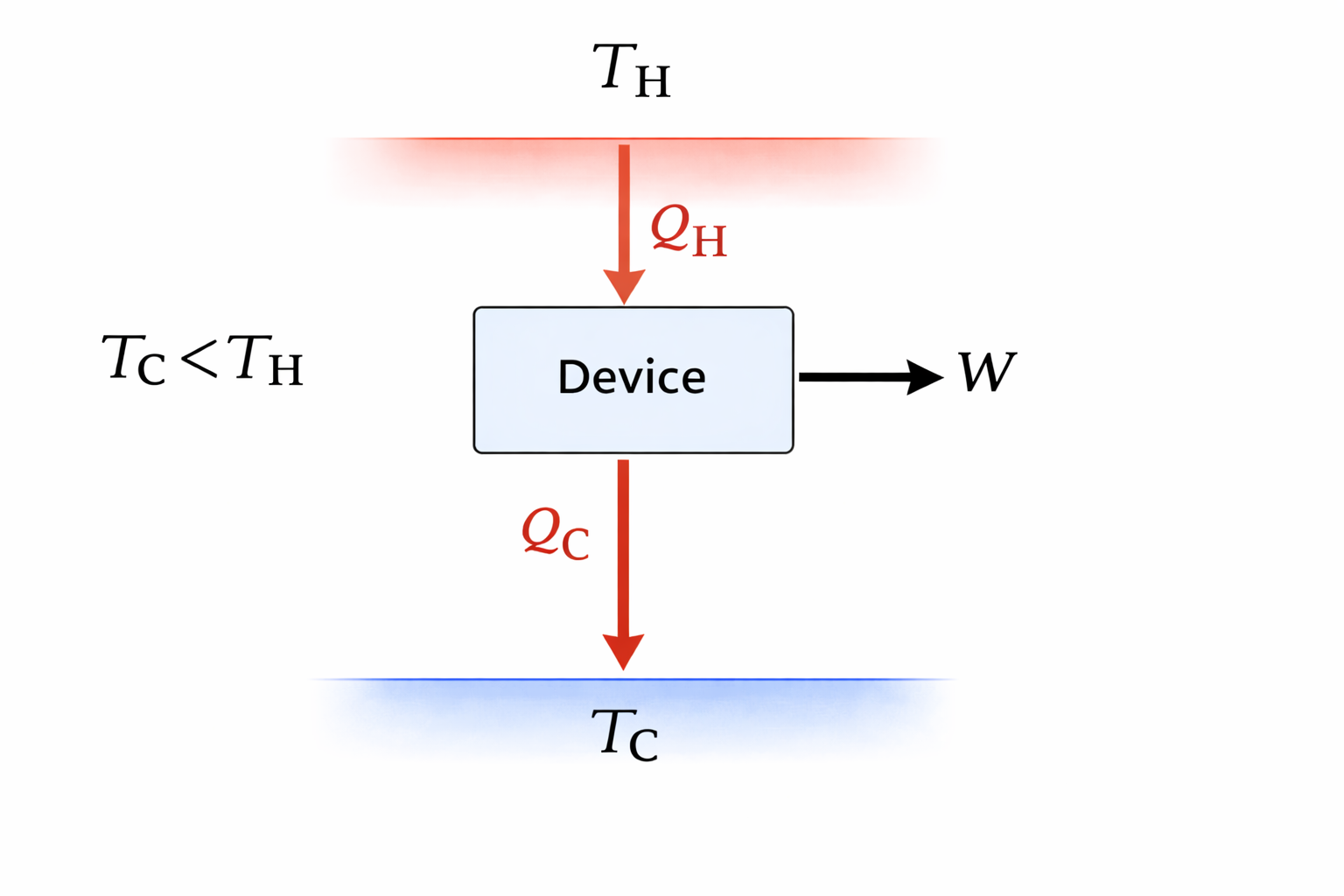
Let’s analyze this Heat Engine:
Heat \(Q_H\) enters from hot reservoir \(T_H\) (\(Q_H > 0\)).
Heat \(Q_C\) leaves to cold reservoir \(T_C\) (\(Q_C < 0\)).
Work \(W\) is produced (\(W < 0\)).
4.1 First Law Analysis
\[0 = Q_H + Q_C + W\] Solving for \(Q_C\): \[Q_C = -W - Q_H\]
4.2 Second Law Analysis
\[0 = \frac{Q_H}{T_H} + \frac{Q_C}{T_C} + S_{gen}\]
Substitute the First Law expression for \(Q_C\) into the Second Law: \[0 = \frac{Q_H}{T_H} + \frac{-W - Q_H}{T_C} + S_{gen}\]
Multiply the entire equation by \(T_C\): \[0 = Q_H \frac{T_C}{T_H} - W - Q_H + T_C S_{gen}\]
4.3 Solving for Work
Now, solve the equation for \(W\):
\[W = Q_H \left( \frac{T_C}{T_H} - 1 \right) + T_C S_{gen} \tag{1}\]
Let’s look closely at this amazing result. Because \(T_H > T_C\), the term \((\frac{T_C}{T_H} - 1)\) is negative. Since \(Q_H > 0\), the first part of the right side is negative (meaning work is produced). However, \(T_C S_{gen}\) is always positive. This positive term makes \(W\) less negative.
- The Potential: The term \(Q_H (\frac{T_C}{T_H} - 1)\) represents the maximum possible work produced by the laws of thermodynamics (when \(S_{gen}=0\)).
- The Reality: The term \(T_C S_{gen}\) represents the penalty for irreversibility. It reduces the actual work produced compared to the ideal maximum.
5 Thermal Efficiency
We define the thermal efficiency \(\eta\) as: \[\eta = \frac{\text{Benefit}}{\text{Cost}}\]
The benefit is the work produced (magnitude \(-W\)), and the cost is the heat put in (\(Q_H\)): \[\eta = \frac{-W}{Q_H}\]
Using our derived expression for work: \[\eta = \frac{- \left[ Q_H \left( \frac{T_C}{T_H} - 1 \right) + T_C S_{gen} \right]}{Q_H}\] \[\eta = \left( 1 - \frac{T_C}{T_H} \right) - \frac{T_C S_{gen}}{Q_H}\]
5.1 Maximum (Reversible) Efficiency
If the process is perfectly reversible (\(S_{gen} = 0\)), we get the theoretical maximum efficiency, known as the Carnot Efficiency:
\[\eta_{max} = 1 - \frac{T_C}{T_H}\]
To maximize efficiency, we want:
\(T_H \to \infty\) (The heat source should be as hot as possible).
\(T_C \to 0\) (Discharge heat to as cold a sink as possible).
This explains why power plants use superheated steam (high \(T_H\)) and cooling towers or cold lakes (low \(T_C\)).
6 Lost Work
Real engines always have irreversibilities (friction, heat loss, turbulence), so \(S_{gen} > 0\). The difference between the maximum (or ideal) work produced and the actual work produced is called Lost Work.
\[W_{lost} = (-W_{max}) - (-W_{actual})\] \[W_{lost} = \left[ Q_H \left( 1 - \frac{T_C}{T_H} \right) \right] - \left[ Q_H \left( 1 - \frac{T_C}{T_H} \right) - T_C S_{gen} \right]\]
\[W_{lost} = T_C S_{gen}\]
This simple equation links the abstract concept of entropy generation directly to lost engineering potential. Every unit of entropy generated destroys our ability to do useful work by an amount proportional to the sink temperature \(T_C\).